What Happens During Removal
| What happens |
What it means for you |
| The room gets sealed in plastic and put under negative pressure before anything is disturbed |
Spores stay in the space we’re working in, not in the bedrooms down the hall |
| Wet drywall, insulation, carpet pad, and trim are cut out and bagged inside the seal |
You lose only what can’t be saved, and the moldy debris doesn’t travel through the house |
| Studs, plates, and slab get cleaned in place, then HEPA-vacuumed and wiped |
The structure stays; the growth on it doesn’t |
| Nothing is closed up until the framing reads dry |
Nobody is hanging new drywall over a wet stud |
| We find where the water got in and tell you what has to change |
Removal with the same leak still running is a repeat job |
| You get a written report of what came out, from where, and why |
Louisiana law requires it, and it’s the paper a buyer, tenant, or adjuster asks for |
When DIY Stops Working
The first thing most people try is a rag and a bottle of something. The second thing is paint. Both change what the wall looks like this week. Neither one changes what is happening inside the drywall, and if the moisture that started it is still there, the stain comes back in the same spot or a few inches to the side.
EPA says bleach is not recommended as a routine practice for mold, and it says not to paint or caulk over it. Drywall, insulation, and carpet pad that have been wet and moldy generally can’t be cleaned; they have to be removed. Dead mold is still an allergen, which is why the standard is removal rather than killing. Paint is not mold remediation.
The 48-Hour Problem
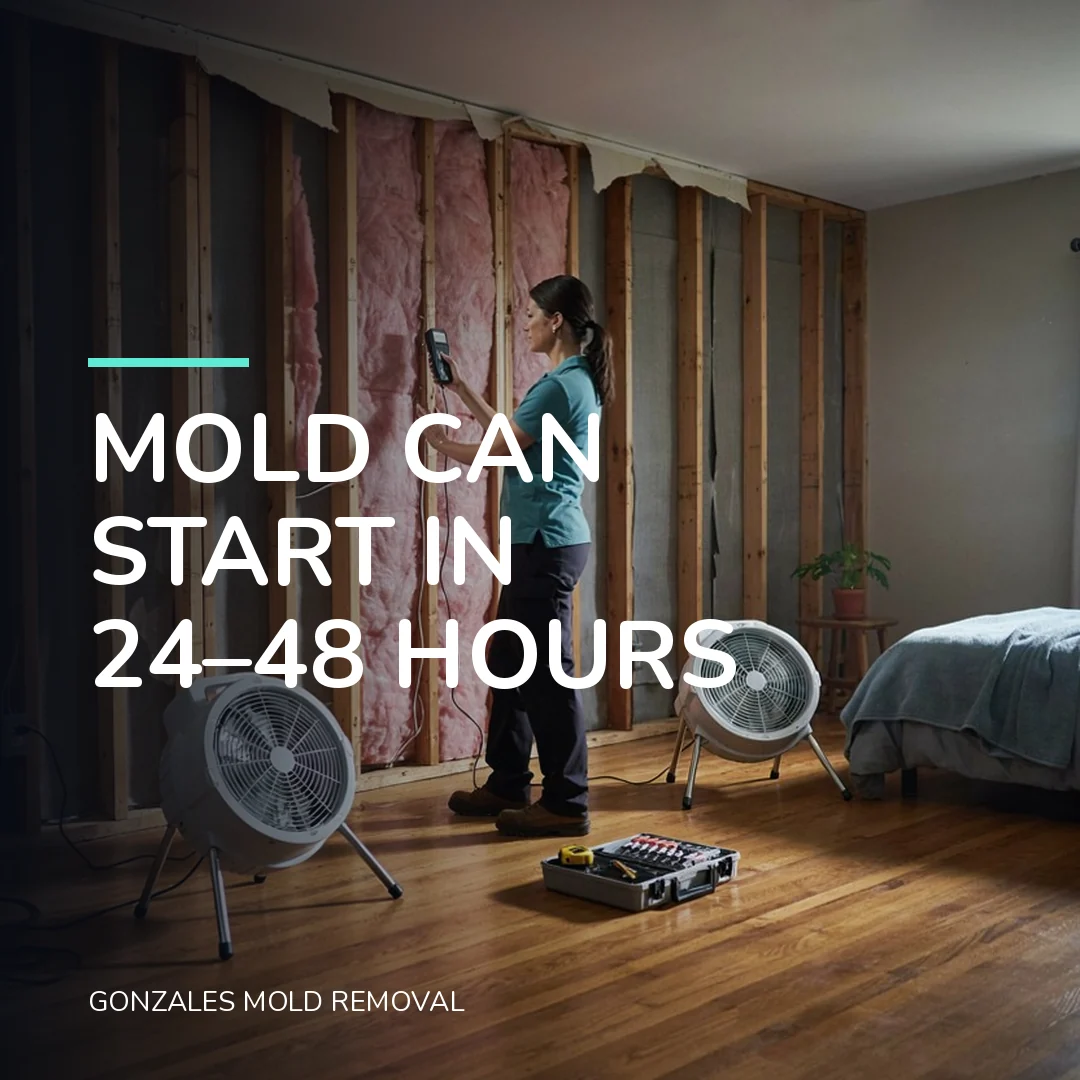
EPA’s guidance is to dry water-damaged material within 24 to 48 hours. CDC says anything wet longer than 48 hours will generally support visible and extensive mold growth. In a sealed, air-conditioned house in Prairieville or Dutchtown, a wall cavity that got wet on Friday night is not going to be dry by Monday morning. It doesn’t need a hurricane. It needs water and enough time, and a slow leak gives it both.
Ascension has its flood history too. In August 2016 the Amite River and its tributaries put water into homes across the east side of the parish — St. Amant, Galvez, the low ground around Sorrento, and neighborhoods that had never flooded before. Only about 23 percent of Ascension homes carried flood insurance, and a lot of the drying and rebuilding was done fast and paid for out of pocket. If a room has smelled wrong since the walls went back up, the flood is over but the mold may not be.
Small Area. Smart Time To Act.
EPA’s rule of thumb is about ten square feet: a patch bigger than roughly three feet by three feet is a job for a professional, and so is anything on drywall, insulation, or inside a cabinet where you can’t see the back of the material. “It’s only a little” is true today. A small spot is the better time to act, because the material that has to come out is one sheet instead of one wall.
In this parish the small spot is often near the air handler. Ascension houses run the AC ten or eleven months a year, and the unit sits in the attic over the bedrooms. A dark ring around one supply vent, a musty smell that arrives the moment the system kicks on, a ceiling stain under the attic pull-down — those point at the system rather than the room. EPA says not to run a system you suspect is contaminated, because it can spread mold through the house, and that insulated duct that got wet can’t be effectively cleaned; it gets replaced. HVAC and duct mold remediation covers what that job looks like.
Renting In Ascension?
Louisiana landlords carry the warranty against defects in the property whether or not they knew about them, and tenants can’t withhold rent to force a repair. With so many rentals here being newer houses in newer subdivisions, both sides sometimes assume the house is too new for this to be their problem. It isn’t. The quickest route for a landlord and a tenant is the same one: get the growth removed and get it documented. Say which side of the lease you’re on when you call.
Selling A Newer Home?
The Louisiana Real Estate Commission’s property disclosure form asks sellers about mold, mildew, water intrusion, and flooding, and it doesn’t care whether the house was built in 1978 or 2019. A known problem that wasn’t disclosed can come back after closing. A known problem that was removed, with the written report Louisiana requires, is a line on the form and a document in the file. With as many houses changing hands in Ascension as there are, that’s worth getting right before the sign goes up.
Call And Tell Us What You Found.
We answer at any hour. Tell us where you see it or smell it, what got wet, and roughly when. If we’re free you’ll be talking to us right away; if we’re on a job you’ll get a scheduled callback, and we’ll tell you which number to watch for.
We take calls from Gonzales, Prairieville, Geismar, Dutchtown, St. Amant, Sorrento, Donaldsonville, Darrow, Galvez, and the neighborhoods between the river and the interstate. Every community we cover is listed on the areas page.
Not sure whether it’s enough to worry about? Call.